Ballyhaunis (Irish: Béal Átha hAmhnais) is a town in County Mayo, Ireland. It is situated at the crossroads of the N60 and N83 National secondary roads and on the railway line connecting Dublin to Westport and Ballina.
It is thought that the town grew up around St Mary's Augustinian Friary (popularly referred to as "the Abbey"), which was founded in 1348, according to local tradition. The town and the surrounding hinterland is steeped in history and contains an extraordinary concentration of megalithic monuments. Local writer Paul Waldron explains that the full meaning of the name Béal Átha hAmhnais remains elusive: "The origins of that name has been the subject of much study and debate over the centuries. Beal Átha means the ford mouth, but what the last element means is still the subject of debate. Suggestions range from derivatives of 'Abhann', meaning river, or of 'amhnas', said to mean 'strife' or 'plunder'."
The town is a mixed community where farming, private business and industry are the main sources of employment. Employment, infrastructure and continued development of the town are key issues addressed by the Ballyhaunis Local Area Plan 2010-2016, adopted by Mayo County Council on 8 February 2010.
It has become a cosmopolitan area in recent decades. Even prior to Ireland's period of economic growth between 1995 and 2007, there were children of at least seven nationalities attending schools in the town. These included Pakistani, Syrian, Russian, English, Polish and Lithuanian. More recently, other nationalities have been attracted to Ballyhaunis, with immigrants from several countries in Africa and Eastern Europe now settled in the area. There are two Catholic churches in the town and it is also home to Ireland's only purpose-built mosque outside Dublin, which is the second most westerly mosque in Europe, after the Lisbon Mosque. The results of the 2006 census showed that some 36 per cent of Ballyhaunis residents are non-Irish. The town's population in the 2011 Census was 3,008.
Ballyhaunis is located in both the Roman Catholic and civil parishes of Annagh
Due to the active East Mayo Brigade of the Irish Volunteers during the Irish War of Independence, Ballyhaunis witnessed a number of incidents. On August 2, 1920, the Volunteers ambushed a British Army lorry on the Claremorris road from Ballyhaunis. This resulted in the capture of arms and ammunition for the Volunteers. A high cross marks the spot of the ambush. On April 1, 1921, Sean Corcoran, O/C of the East Mayo Brigade, was shot dead by British soldiers after a short gunfight at Crossard crossroads (6 km north of Ballyhaunis). A high cross marks the spot where Corcoran died. Later that same day, a member of the Black and Tans was killed by a sniper. In retaliation, the Black and Tans executed Michael Coen, a man that was later proven not to have taken part in fighting of any kind. A monument to Coen was placed on the Cloonfad/ Galway road from Ballyhaunis.
According to Mayo County Council, four buildings in the town are protected under Part IV of the Planning and Development Act 2000.These include:
St Patrick's Parish Church (RC).
The former St Joseph's Convent.
St. Mary's Augustinian Friary.
The Ulster Bank.
Midwest Radio is based at Ballyhaunis. It is a local radio station for Counties Mayo, Roscommon, Sligo and Leitrim.
It has also a dedicated internet radio, Midwest Irish Radio.
Annagh Magazine is an annual publication that appears each December containing material of local interest. It was established by Ballyhaunis Junior Chamber in 1977 and named after the local parish. The first edition was published in Christmas 1978. It includes articles about local events over the past year as well as contributions covering Ballyhaunis history and culture. The 2011 edition contained 184 pages and cost €10. All back issues are digitized and available online at no cost from the magazine's website
Notatable People
Patrick Gallagher — Vietnam war hero.[14]
Frank Greally — Athlete, sports commentator, founding editor of Irish Runner Magazine.
Liam Harte — Author and university lecturer.[15]
John Heavey — Bishop of Cairns, Queensland, Australia, (1941–1948).[16]
Jim Higgins — Member of the European Parliament.
Keith Higgins — Full back on the senior Mayo football team.
Anthony Jordan — Author and biographer.
Walter "Fulgentius" Jordan — Augustinian friar murdered by Cromwellian soldiers in 1649.[2]
Patrick Lyons — Antiquarian, Honorary Member of Royal Society of Antiquarians of Ireland.[17][18]
James McGarry — Biomedical engineering award winner.[19]
Maria McGarry — Classical Pianist.[20]
Patrick McGarry — Prize winning biomedical engineering scientist.
Bill Naughton — Playwright; wrote Alfie (1963), the basis of two film adaptations.
Gabriel Pratt — Astronomer; fellow of the Max-Planck Institute.
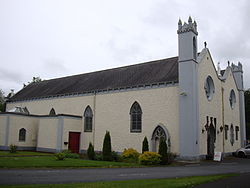
Ballyhaunis Friary